

Midnight sun golf
Midnight sun golf at Lofoten Links – an experience you can only find 30 minutes away Astra Village
Discover the history of Kabelvåg – one of Northern Norway's oldest towns and the center of the legendary Lofoten fishing through the centuries.

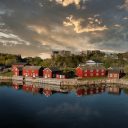
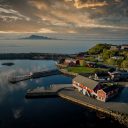
First-time visitors to Lofoten are often struck by the dramatic landscape. Sharp mountains rise straight up from the sea. Red rorbuer clinging to the rocky cliffs. The Arctic light changes the landscape hour by hour, creating motifs that almost seem unreal.
But behind the spectacular surroundings lies a story that is at least as fascinating.
Long before Lofoten became one of the world's most sought-after travel destinations, this was an area of great importance to Norway's economy, culture and identity. At the heart of this history lies Kabelvåg.
Today, Kabelvåg is a charming town with around 1,500 inhabitants. Here you will find galleries, cafes, fishing boats, historic buildings and a short distance to some of Lofoten's most beautiful nature experiences. The atmosphere is calm, authentic and down-to-earth.
But more than a thousand years ago this was one of the most important places in Northern Norway.
The story of Kabelvåg is in many ways the story of all of Lofoten.
To understand Kabelvåg, you must first understand the sea.
Every winter, one of the world's largest natural migrations takes place beneath the ocean surface in northern Norway. Millions of cod swim from the Barents Sea south towards the spawning grounds around Lofoten.
This cod, known as skrei, has for centuries formed the basis for life and settlement along the coast.
The migration is so predictable and the fish stocks so abundant that the area developed into one of Europe's most important fisheries.
For generations, fishermen from all over Norway traveled to Lofoten to participate in what later became known as Lofoten fishing. The waters around what is now Kabelvåg offered ideal conditions.
The harbor provided shelter from the weather and wind.
The fishing grounds were easily accessible.
The area therefore became a natural gathering point for fishermen, traders, craftsmen and authorities.
By the Middle Ages, the settlement, then called Vågar , had developed into the region's most important center.
Although Kabelvåg today appears as an idyllic village, medieval Vågar is often referred to as Northern Norway's first urban community.
The term "city" had a different meaning in the Middle Ages than it does today, but Vågar had many of the characteristics associated with an urban center.
People lived here permanently.
Trade flourished.
Goods came from far away.
Merchants established themselves.
Ecclesiastical institutions gained a foothold.
Representatives of the royal government visited the area.
The economic activity extended far beyond fishing itself. The importance of the place was so great that it caught the attention of the kings of Norway.
In the 12th century, King Øystein Magnusson is said to have established one of the first rorbu systems in the area. Here fishermen from other parts of the country could stay during the fishing season.
The king understood what many already knew:
Control over the fisheries meant access to wealth.
The fish caught around Lofoten not only filled local stomachs, it connected Northern Norway to the rest of Europe.
For centuries, large parts of the catch were processed into stockfish – a product that would become one of Norway's most important exports.
The method was simple but ingenious.
Fresh cod was hung on large wooden racks, known as fish racks, where wind, cold and sea air gradually dried the fish.
No salt.
No smoking.
No artificial preservation methods.
Only nature's own forces.
The result was a light, nutritious and durable product that could be transported over long distances.
Stockfish from Lofoten found its way to markets all over Europe.
Especially in Italy, it was highly valued – and it still is.
Through this trade, the small fishing villages in the north were linked to international trade networks several hundred years before globalization became a familiar concept.
And much of this trade went through the port of Vågar.

When you walk through Kabelvåg today, you find traces of history everywhere.
The relationship between humans and the ocean is still evident.
Fishing boats are still docking.
Traditional wooden houses stand side by side with modern buildings.
The wharves tell the story of a society that has always lived close to the sea. Unlike many places where history is experienced as something distant, the past is still a part of everyday life in Kabelvåg.
Children grow up surrounded by stories about fishermen and seafarers.
Families carry on traditions that stretch back generations.
History is not only found in museums.
It is still alive.

Just outside the city center lies Storvågan, one of Northern Norway's most important cultural and historical areas.
Archaeological finds show that people have lived and worked here for many hundreds of years.
Today, visitors can explore the area through museums and cultural attractions that provide a vivid insight into the history of Lofoten fishing.
Storvågan reminds us that Lofoten's success was never accidental.
Generations of people learned to live with the rhythms of nature.
They developed skills, traditions, and knowledge that made it possible to create prosperity in an environment that could be both rich and unforgiving.
Today's Kabelvåg is naturally different from medieval Vågar.
The large seasonal markets are gone.
Fishing technology has been modernized.
Transportation and communication have changed everyday life.
Nevertheless, much of the place's character has been preserved.
Visitors are often surprised by how authentic the place feels.
This is not a community built just for tourists.
People live here all year round.
Fishing is still important.
Artists and craftsmen leave their mark on the local community.
Boats come and go from the harbor every single day.
The pace is slower than in many other places in the world, and that's precisely why many find something they miss: a sense of true belonging.
Many people come to Lofoten with a focus on spectacular mountain peaks, iconic viewpoints and beautiful pictures.
It's easy to understand why. But those who take the time to discover Kabelvåg will get something more.
Here the landscape gets a story.
You understand how people survived.
How societies were built.
How fishing created culture.
How international trade found its way to the Arctic.
And how a small community became one of the cornerstones in the development of Northern Norway.
Nature captures attention.
History makes sense.
Kabelvåg offers something more and more travelers are looking for: real experiences.
The story is not constructed.
The culture is alive.
The connection to the sea is still visible every single day.
For those who want more than beautiful photographs, Kabelvåg offers an opportunity to experience the deeper history of Lofoten – the story of fishermen, traders, kings, the sea and the people who created a basis for life on the far side of the ocean.
Because if there is one place where the story of Lofoten begins, it is here.
Midnight sun golf at Lofoten Links – an experience you can only find 30 minutes away Astra Village

How a migrating cod created wealth, trade and society in Lofoten – and helped build Norway as a nation.

There are meetings – and then there are moments that actually move something.