History
Lofoten has always been about direction.
For more than a thousand years, people have sought this place – for the sea, the fjord, trade and light. Kabelvåg, the old Vágar, grew up as one of the most important places in Northern Norway, a hub for fishermen, traders, the church and royal power. Here the foundations were laid for much of what we today associate with the history of Lofoten. Astra is at the heart of this story. Inspired by the stars that for generations have guided people along the coast, we want to preserve the place's history - while creating space for new experiences.

Long before Lofoten became a tourist destination, the archipelago was a place of work.
The sea was the basis of life, and the skrei that came in from the Barents Sea every year made Lofoten one of the most important fishing areas in the country. Kabelvåg – the old Vágar – is considered Lofoten's oldest fishing village and a historical center for commercial Lofoten fishing. Already around the year 1100, Vágar grew up as one of the first urban formations in Northern Norway, linked to the catching, production and export of stockfish.
Fishermen came here from large parts of northern Norway, and the place became a meeting point for trade, church and royal power. According to tradition, King Øystein Magnusson had both the church and rorbuer in Vågan in the 12th century. That says a lot about the importance of the place: This was not just a fishing village, but a point of reference in the north – a place where people sought, worked from and found their way back to. Gradually, the center of gravity shifted from Storvågan and towards today's Kabelvåg.
Port conditions, trade, settlements and the growing Lofoten fishing industry made Kabelvåg a vibrant centre. At the end of the 19th century, Kabelvåg was among the most important fishing villages in Lofoten, and the Lofoten Cathedral – Vågan Church – was built in 1898 with space for around 1200 people, precisely to accommodate both the local population and the many fishermen who came here during the season. The story of Astra Village is part of this larger narrative.
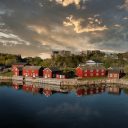
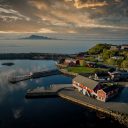
The fishermen's huts known as Statsbuene were built by the Norwegian State Harbour Authority in 1928 as a measure to provide better living conditions for visiting Lofoten fishermen. They were built at the breakwater in Kabelvåg, several of them partly on piles over the sea, as modern experimental huts for their time.
Today the function is different, but the proximity to the sea is the same. What were once simple quarters for fishermen have now been restored and adapted for guests who want to experience Lofoten with comfort, tranquility and respect for the place's origins.
Astra is therefore not about erasing history, but about carrying it forward. Just as the stars once helped people navigate along the coast, we want Astra to be a fixed point of reference – a place to land, find direction and experience Lofoten with greater intimacy.
